

It’s said that men are attracted to women similar to their mothers, but tiny, adorable Rinko Yamato bears little resemblance to Takeo’s burly, no-nonsense mother Yuriko. Mama Gouda is the source of her son’s exceptional physique, compassionate nature, and drive to protect the vulnerable. While Yamato’s cuteness and femininity make her relatable, Yuriko sends the message that those qualities aren’t mandatory to be loved and worthwhile, and that there’s more than one way to be a woman.
Early in the series, Yuriko tells her son, “You’re going to be a big brother soon.” Takeo, while happy, grows concerned, both for her age and the bags of groceries she’s carrying. Irritated, she tells him that she carried plenty of heavy things when she was pregnant with him, and that she’s “chronologically 40, but the doctor says [she’s] physically 22.” Takeo’s insistence on sheltering his mother, who continues to carry heavy grocery loads and do all the same physically taxing housework, is a regular source of annoyance to Yuriko. 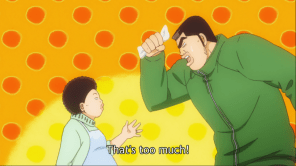 Pregnant women are often dehumanized – we treat them as if they’re made of glass, and the baby growing inside them is more important than they are themselves. Every body responds to pregnancy differently, and some women are just as capable of hard work as they are at any other time in their life. Tough-as-nails Yuriko has already survived one pregnancy without anyone sheltering her, and she’s just as fit as she was back then. She takes pride in her work taking care of the home. No wonder she gets cranky when her son acts like he knows better, even if it is coming from a good place.
It’s no wonder Takeo managed to forge such a strong, equal relationship with Yamato. He has a great model for it: his own mother and father. Though it does fall along traditional gender lines, with his mother staying at home to care for the apartment and his father working, there are signs that the two share a more equal relationship than most. Whenever his father, Yutaka, gets home, the first thing he does is go clean the bathtub. When baby Maki is born, he is also shown playing with her. 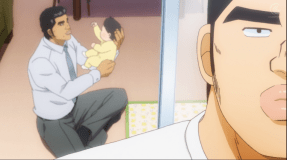 These are small things, but with the division of labor as extreme as it tends to be in Japan, it can be difficult for fathers to be even that involved. Husbands being more involved in caring for the home is linked to greater satisfaction in marriages, and Yutaka and Yuriko have clearly created a healthy and loving home environment for Takeo. Yutaka clearly appreciates his wife for who she is, with her physical and emotional strength. He tells Takeo the story of how he fell in love with her: when they were young, they worked in the same office.
  At a work outing, Yuriko saved a co-worker from a falling pot of hot water, getting hit by the scalding water in her place. When Yutaka went to check on her, she said, “When I see cute girls like her, I just want to protect them, you know?” Yutaka continues, “For the first time in my life, I thought I’d want to ride out the turbulent waves of life with someone like her!” He proposed by saying he wanted to protect her, but “[she’s] so strong, I’ve never gotten around to protecting her.”
Yuriko’s protective instincts and her emotional strength are a major part of her self-identity. While Takeo is out buying those groceries he refused to let her carry, she tells Yamato, “Men are such wimps, women have to be the strong ones.” While I’m not a fan of gendered statements like that, truth still rings through the line. Yamato is confused, saying that Takeo is plenty strong, but Yuriko tells an anecdote from when he was five and ran into the street. He was almost hit by a car and she had to dive to protect him, scraping her arm in the process. Takeo panicked and begged her, “Don’t die, Mom!” 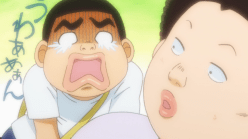 Strength comes in many forms, and the form she refers to here – protectiveness, self-sacrifice, and keeping a brave face in a crisis – are commonly associated with motherhood. Yuriko displays this strength many times in the episode, but it comes at a price. When a fellow pregnant woman she met at the clinic slips on some steps, Yuriko catches her, but her own belly ends up absorbing the impact. She ends up going to the hospital and entering labor early, even giving up her wheelchair to the delivery room so the first-time mother-to-be sharing her room could have it. Along every step of the way she puts on a brave face for her son and his friends, shooting them a thumbs up and a wink even as she’s doubled over in pain. She even tells them flippantly, “I’m going to push one out now!” Hiding her pain and fear is the only way she can take care of Takeo in her current position; otherwise, he’d lose his mind with worry.
  She only drops her brave face in front of her husband, telling him sadly, “I wonder if our baby’s mad at me…” Yutaka reassures her, “You just wanted to protect them both.” Even the strongest feel vulnerable sometimes, and seeing the emotional partnership between the couple is touching.
When OreMono came out, some wondered if a series where Takeo were the girl would ever be viable. Well, she may not have a whole series focused on her, but that is Yuriko Gouda’s story. A woman who, though not traditionally beautiful, is admirable and beloved because of the power of her compassion and who thinks nothing of sacrificing herself to protect others. The Gouda family is beautiful because it shows that not just one kind of woman is worthy of love, and that you don’t need to change who you are to fit artificial ideas of how you should act because of your gender. When I become a mother myself, I hope I can be as strong – physically and emotionally – as Yuriko.

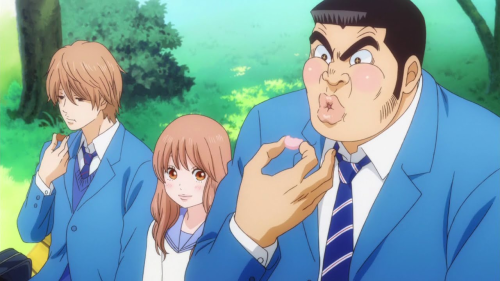
 She also loves Takeo, but also gets frustrated when he treats her like she’s made of glass.The show does has a problem early on where it sets Yamato’s attraction to Takeo up in opposition to every other girl he encounters. Whenever he helps one, they’re terrified of him but thank handsome Suna instead. Even Yamato’s friends judge him by his unconventional appearance. As a result, women other than Yamato come across as superficial and shallow at first, but the situation improves as the show introduces more fully-realized women. Together, they form one of the kindest, sweetest pairs to be found in the romance genre and even their most mundane conversations are enjoyable.
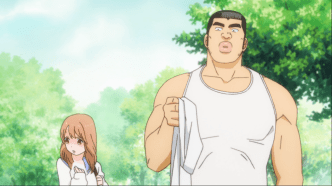 When she starts acting distant, Takeo is puzzled. Shouldn’t she be more at ease? Both Yamato and Takeo have grown up in a culture that values female sexual purity and treats female sexual desire as an aberration, so it’s unsurprising that when Yamato hears that, her response is of guilt and shame. After all, she admits to Ai Sunakawa, Suna’s older sister, her attraction to Takeo is just as much physical as it is mental and emotional. She “has impure thoughts” and wants to do things like “holding hands”. (How brazen!) When she confesses this to Takeo, she actually has tears in her eyes.
 but it also shows that it’s okay to have unconventional taste. Often when female characters are paired with male characters who aren’t conventionally attractive, it’s despite his looks. This sets the expectation that women should be less concerned with physical and thus sexual attraction, reinforcing the implicit belief that women who do care are shallow or sluts. With an everygirl like Yamato, it’s a powerful message.
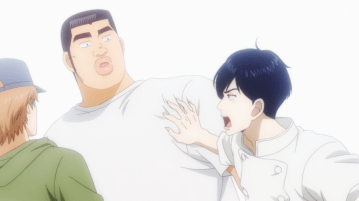 When Yamato, working at the same patisserie, compliments one of his cakes, he falls for her hard – so hard, in fact, that he asks Takeo to break up with her. The way he sees it, he’s better for her in every way. They have common interests, unlike the culinarily-challenged Takeo, plus he’s traditionally attractive, at the top of his field, and older. He even has a car, a major symbol of adulthood and status in teen-oriented manga. When Takeo refuses, Ichinose comes up with a new plan: if he wins an upcoming national pastry contest, he’ll confess his feelings. He never even bothers to entertain the idea that she’ll reject him. Takeo is jealous and protective in part because he agrees that Ichinose is, on paper, a better match for her. After struggling with those feelings, he decides that if she really does end up wanting to leave him for Ichinose, he’ll be the bigger man figuratively as well as literally and support her. Yamato’s happiness is priority one for him and he doesn’t want to keep her trapped in a relationship if there are better prospects. Still, he waits for Yamato to make her own decision rather than breaking up with her like Ichinose requested, because it’s her choice to make. His approach to the situation is far more emotionally intelligent than Ichinose’s, even if he is plagued by doubt. Ichinose, on the other hand, is presumptuous and self-absorbed. He starts using her given name the same day he meets her, a step Takeo hasn’t even managed to take after almost a year of dating. When she talks, he usually makes wild assumptions about what she really means, projecting his own feelings onto her. He puts her on a pedestal, going so far as to declare her his ‘muse’.

 I Have a Heroine Problem