As presented at Otakon 2016 with Rose Bridges











Summary: Moritaka Mashiro likes to draw, but it’s not what he considers his defining trait. After his uncle, a formerly-popular mangaka, died of overwork trying to replicate his own success, Moritaka never really considered art a serious endeavor. One thing he does take seriously, however, is his crush on his cute classmate Miho Azuki. When the smartest boy in his class, Akito Takagi, finds a sketch Moritaka drew of Azuki, he suggests they team up to create manga together. Moritaka has misgivings at first – trying to break into the field is too big a gamble – but before he knows it, the two grow determined to get their manga into the popular Jump magazine.
Content warnings: a whole lot of sexism, but nothing worse than that
Would I recommend it: HAHAHAHAHAHAHAHAHAHAHAHA no
Note: I apologize for the quality of the images – I took pictures of the book using my phone
I’ll be honest here – I did not go into Bakuman in good faith. I started it knowing full well about Ohba and Obata’s disdain for women. The series is well-loved and critically acclaimed enough that I’m sure that there’s plenty to like about it, but since I am specifically taking aim at the parts that frustrate and anger me, I’m pretty much blind to those elements. No, I read Bakuman expecting to hate it and, shockingly, was correct.
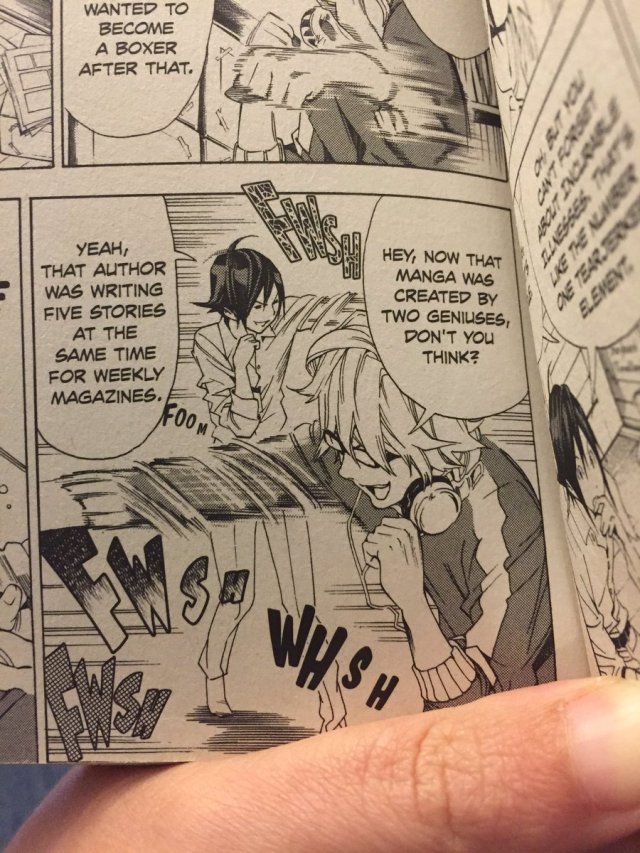
There’s a lot of ways for media to be sexist. Objectification and male gaze are constant sources of irritation even in otherwise good series; and with some series it’s as simple as forgetting women exist beyond decorations and failing to give them a role to play in the story. I wouldn’t describe any of these as actively misogynist so much as thoughtless adherence to pre-established tropes and expectations. That’s what makes it frustrating that it’s as prevalent as it is. That also has the side effect of making it shocking to come across a series that doesn’t just ignore or marginalize women, but treats them with active scorn. That’s why when I read the first volume of Bakuman, by the same writer/artist team as Death Note, I was taken aback by its naked misogyny.


OVA
Summary: If you met Yomiko Readman on the street, you’d think she was a shy, awkward young woman who lived her life in the pages of a book. You’d be right, of course, but you probably wouldn’t guess that she’s also The Paper, an agent of the British National Library with the power to wield paper as a weapon. When a group of superpowered clones known as I-Jin attack, determined to get their hands on a copy of Beethoven’s Immortal Beloved Yomiko picked up by chance from a used bookstore, it’s up to Yomiko and her new partner, Nancy “Ms. Deep” Makuhari, to stop them.
Content Warnings: Abusive relationships
Would I recommend it: Sure! It’s a fun little action romp.
In 2002, the OVA of Read or Die was released in the US, despite being a sequel to a manga that had not been commercially translated into English. Despite the lack of context, it seemed to be tailor-made to be a hit with Western audiences, driven primarily by exciting action set-pieces with superpowers and the sci-fi twist of villains based on historical figures. Its slim 100-minute running time leaves little for character development and, considering its status as a sequel, doesn’t really prioritize it. Despite that, or perhaps because of it, there is an effortless sense of characterization, allowing first-time viewers to get a sense of its two main characters as people. Yomiko Readman and Nancy Makuhari could easily have been a helpless moe girl and a fan service vehicle respectively, but are instead given a surprising amount of depth.


Why does it matter? Why should we have these conversations? It’s not like a headstrong girl will go out and read a shoujo manga about a girl in a relationship with an abusive boy and instantly become a doormat. But it normalizes and romanticizes abusive behaviors and creates a culture of abuse. Once again, I want to emphasize, if a girl reads a manga and thinks that it’s okay to be treated like this and someone proceeds to, it’s not her fault. It is not her fault! This creates a culture of abuse that associates aggression and dominance with masculinity and sacrifice of the self for the sake of romance: “I love him, therefore I have to put up with this. He only treats me like this because he loves me.” These are very common cultural myths that need to be actively combatted and actively talked about and criticized, or else impressionable young readers – I started reading manga myself when I was about twelve years old, well before I had ever been in a relationship and while my personality was still forming. Luckily I was also reading things like Tamora Pierce, who writes about confident young women, though she has her own issues, like the age difference thing…
Continue reading “Romance and Abuse in Shoujo Manga Part 4 – Conclusion”


Now we’re getting more into the actual, physical forms of abuse that are not just tropes in fiction. This is physical abuse – pulling hair, punching, slapping, kicking, biting, anything that brings harm to your body. Damaging your property out of anger. Forcing you to use drugs or alcohol was a really weird one in Hana Yori Dango because he kidnaps her, drugs her, and she wakes up to being given a makeover, and that’s like, “Oh, he just doesn’t understand how to be nice to her, that’s why he did that. He was just trying to be nice!” He drugged her. He drugged her. The property tends to involve phones, because that is an avenue of communication with other people. If they’re communicating with other people, the guy will destroy the phone in a temper tantrum.
Continue reading “Romance and Abuse in Shoujo Manga and Anime Part 3 – Signs of Abuse”


One of the things people brought up as something that made them uncomfortable was age differences. It’s a very common fantasy for young women, which is why it’s so common in shoujo manga. “Oh, this hot teacher… he’s so attractive… What if he fell in love with me?” And people generally mentioned Sailor Moon, because Mamoru is in college and Usagi is in middle school; and this particular couple in Cardcaptor Sakura, because she’s in elementary school and he’s her teacher. [audience groans]
It is a common fantasy, but there’s an inherent power imbalance here, and all the time you see stories about young women who end up sleeping with their teachers and it’s what they thought they wanted – and this is not victim blaming, it is 100% on the adults to not do it with them – but since they see these fantasies, and they find themselves in these situations, they don’t have the tools to get away. Once again, I want to emphasize, it is never the victim’s fault. I don’t want to come across like I’m victim-blaming, ever.
Continue reading “Romance and Abuse in Shoujo Manga and Anime Part 2 – Tropes”

At this year’s Sakura Con, I had the amazing opportunity to present a panel on Abuse in Shoujo Manga and Anime to a completely full room. Starting today, I will be posting a transcript of the panel in four parts. Because of the more spontaneous, imperfect nature of speech, the my thoughts and grammar will be messier than usual.
Hi everyone, my name is Caitlin Moore. I write for the blog heroineproblem.com, and thank you so much for coming to “Romance and Abuse in Shoujo Manga and Anime”. I chose this panel because growing up, I read a lot of shoujo manga, and as I got older, I was reading and realized, a lot of these guys are just not good! They’re not good guys! I started thinking about exactly how relationships work and how people in relationships should treat each other. As I started getting older and getting into feminism, it only got more alarming to me.
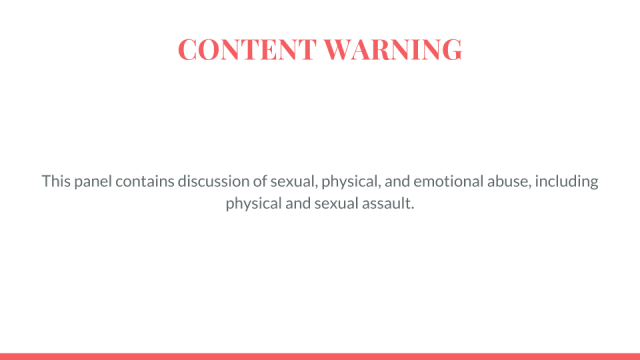
So, just a content warning: this panel will contain discussions of sexual, physical, and emotional abuse, including sexual assault. If anyone thinks they need to leave for any reason, that’s fine, no judgment.
Continue reading “Romance and Abuse in Shoujo Manga and Anime Part 1 – Introdution”

Q: This is a question for both of you. When you were growing up, what was your favorite manga or anime series, and as of right now, do you happen to have any manga or anime titles that you’re enjoying at the moment?
TK: I think if you compare director Matsumoto and me, there’s maybe a difference of two generations… or maybe just one. The generation gap is kind of like parent and child, almost, so I’m sure we were drawn to different things when we were young. In my generation, one of the works that sparked this animation trend was Spaceship Yamato, and also works that were created by Leiji Matsumoto. I was really inspired by those works. Right now, I need to look at other anime to learn what styles they’re using and what new process they’re using. The animation studios I’m interested in right now include Kyoto Animation and Studio Ghibli, so I see works from those so I can learn and incorporate what they do into my work.
RM: Since I was very small, I was really interested in Japanese fairy tales and there were anime versions of those shows on TV, so I would watch those a lot. I was also a fan of things with anthropomorphized animals. For example, there was one that took place in a zoo like with a penguin, and it was the humanized animals living out a human drama. I liked that sort of thing. Often I would meet these shows randomly, by accident when watching TV or something. When certain things are handled in live-action dramas or with human characters, they have a lot of heavy themes like divorce or losing family, but in those shows, since the characters were animals, it kind of softened it so kids were able to watch it, and it was kind of like practice for entering society and I feel that I learned a lot from those. Also, there were a lot of really quality shows at the time that I was in elementary and middle school, like Cowboy Bebop that Kawamoto-san had done.
Continue reading “Sakura Con 2016: Rie Matsumoto/Toshihiro Kawamoto Interview, Part 2”

At Sakura Con this year, I had the incredible fortune to participate in a round-table interview with Guests of Honor Toshihiro Kawamoto and Rie Matsumoto. Kawamoto earned his place in animation history as a founding member of Studio Bones and one of anime’s foremost character designers and animators, with credits including Cowboy Bebop, Ouran High School Host Club, and most recently, Blood Blockade Battlefront.
Matsumoto is one of anime’s rising star directors. In an industry dominated by older men, she has directed three major works at the age of 30, including a Pretty Cure film and smash hit Blood Blockade Battlefront.
Rie Matsumoto: I am Rie Matsumoto and I’m a director.
Toshihiro Kawamoto: Hi everyone, my name is Kawamoto. I’m from Studio Bones and my roles are character designer and animator. Today, I am here with the director to promote Kekkai Sensen together.
Continue reading “Sakura Con 2016: Rie Matsumoto/Toshihiro Kawamoto Interview Part 1”
This year, I was more excited for Sakura Con than I have been for a convention in a long time. I had friends coming in from out of town, was doing three panels, and looking forward to seeing Rie Matsumoto, one of the most talented directors working in anime. Sure, I was broke, but that’s been the case at conventions for the last… five years? Ten years? Since I moved back to the US, for sure. It’s hard out there for a preschool teacher/blogger. But that doesn’t really matter – I’m not much of a Collector of Things. I’m happy keeping my convention budget to the con membership.
 I Have a Heroine Problem